Notcoin connects Telegram games and Web3 exploration with the TON blockchain
Notcoin is a crypto project built on TON that combines a tradable token, Telegram games and rewards for discovering Web3 projects. Its token is NOT. The project began with a tapping game, then expanded into activities such as Not Pixel, Lost Dogs and Explore campaigns. Each component has its own purpose and reward rules. The original tapping phase ended in 2024, so its historical game balances need a different interpretation from the token and later ecosystem activities.
Telegram joins the games, discovery campaigns and community
Telegram provides the setting for the project's games and community, while TON provides the blockchain that supports its token. TON stands for The Open Network. A mini-app runs within Telegram and gives an activity its interface. Blockchain execution handles the on-chain asset; actions inside a game can happen off-chain. This arrangement creates different entry points: playing a game, discovering a partner project through Explore or acquiring NOT through a supported trading service. Game rules govern play, campaign terms govern rewards and the trading venue governs an order. The shared community connects those activities without giving them identical costs or entitlements.
Painting and shared decisions give the games different purposes
The games extend the ecosystem through different forms of participation, including pixel painting and community decisions that influence a story. The original clicker supplied the project's early tapping format; later games developed other ways to involve the community.
Not Pixel turns painting into participation
Not Pixel centres on painting pixels. Painting earns PX under the game's reward rules. The wider project's token identity does not determine what reward the painting activity offers, how the game calculates it or when it becomes available.
Lost Dogs makes community choices part of the story
Lost Dogs: The Way introduced a choice-based game in which participants cooperated with the community and considered possible outcomes. Decisions influenced the dogs' story. Its announced campaign included NOT and WOOF rewards, with game-specific rules. That describes the campaign's reward design without establishing that the same season or payout remains available today.
Explore connects project discovery with campaign rewards
Explore connects users with partner Web3 projects and rewards participation in the activities that a campaign specifies. Web3 refers here to products that use blockchain-based assets or services. Campaign conditions determine which contribution qualifies and what the participant can receive. Kraken's September 21, 2024 disclosure described the former staking program for partner missions as inactive.
Project builders use these campaigns to introduce their products to the community. The relationship runs in both directions: a project receives participation, while qualifying users receive the campaign's reward. This differs from buying NOT on a market, where a filled order exchanges assets at its execution price. Campaign participation does not create a universal earning rate across all projects, and a completed activity only qualifies under the offer's applicable rules.
How did the tapping game become a tradable token?
The tapping game led to a blockchain token through NOT's launch on TON on May 16, 2024. The game and token belonged to connected phases with different units.
A beta began in November 2023. The public Telegram mini-app launched on January 1, 2024, letting players tap a coin icon to accumulate balances off-chain.
The original tap-to-earn phase ended on April 1, 2024. Its balances then froze. The May launch converted 1000 in-game units into one NOT token.
The conversion turned eligible in-game balances into allocations of transferable NOT tokens. It did not make every earlier tap an on-chain transfer. The token-generation event supplied the transition, while distribution and claiming determined where an allocation reached its recipient. An old game counter and a wallet's NOT balance consequently cannot be read as interchangeable quantities.
The clicker attracted 35 million users before the token launch. That historical participation figure measures the game's audience. It does not describe today's active players, unique token holders or people eligible for a later campaign. The original game's popularity helps explain the community that subsequent games and Explore activities could reach.
Memes and contests give the community another outlet
Memes, contests and social activity give the community ways to participate beyond token acquisition. The project's recurring phrase, probably nothing, belongs to that culture. The project has held contests for Coub meme videos, with rewards for winners selected by community votes. Each contest's terms determine eligibility and rewards; sharing a meme alone does not establish a NOT allocation.
Does an ecosystem game promise a NOT payout?
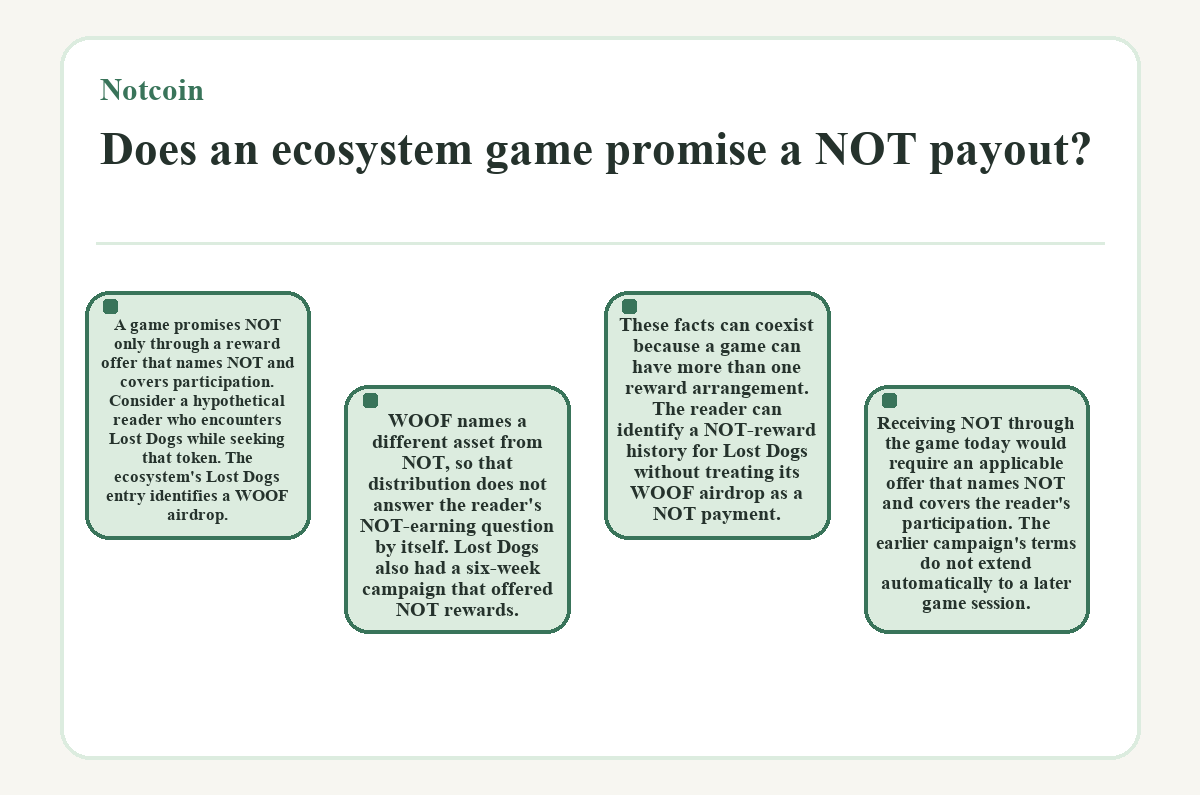
A game promises NOT only through a reward offer that names NOT and covers participation. Consider a hypothetical reader who encounters Lost Dogs while seeking that token.
The ecosystem's Lost Dogs entry identifies a WOOF airdrop. WOOF names a different asset from NOT, so that distribution does not answer the reader's NOT-earning question by itself. Lost Dogs also had a six-week campaign that offered NOT rewards. These facts can coexist because a game can have more than one reward arrangement.
The reader can identify a NOT-reward history for Lost Dogs without treating its WOOF airdrop as a NOT payment. Receiving NOT through the game today would require an applicable offer that names NOT and covers the reader's participation. The earlier campaign's terms do not extend automatically to a later game session.
Burning removes tokens without setting their market price
Burning removes tokens from supply, changing the quantity that remains available. NOT burns have included unclaimed clicker allocations, amounts associated with Explore pools and donations. A burn does not fix the price that buyers will pay for remaining tokens. Demand and market liquidity still affect that price, so a burn total and a trading return measure different things.
What changes when NOT reaches a wallet?
Once NOT reaches a TON wallet, the balance represents an on-chain token allocation associated with an address and its custody arrangement. NOT is a jetton on the TON blockchain. A jetton is a fungible token: units of the same token are interchangeable. Its master contract identifies the token and tracks supply, while separate jetton wallet contracts hold individual balances.
Custody determines who authorizes movement
Self-custody keeps signing control with the owner
In self-custody, the wallet owner controls the keys that authorize movement of their NOT. The wallet application presents the balance and prepares requests, while the blockchain records token transfers. Access to the relevant keys therefore matters more than the continued availability of a particular game interface. A recovery phrase can provide control of those keys, making it sensitive wallet information.
A custodial account follows the service's withdrawal rules
A custodial service manages the keys and credits the user's account within its own system. A displayed NOT balance there represents the service's account record. Moving assets to a personal wallet involves the service's supported withdrawal process. Account access, token custody and withdrawal support are separate properties, even when the service operates through a familiar Telegram interface.
Trading access and costs depend on the route
NOT trading access includes centralized exchanges, decentralized TON exchanges and supported app-based services. Services such as Binance and Revolut provide access within their supported markets. These services have different account requirements and transaction arrangements. A listing establishes an available market or product within a service's scope; local eligibility and supported deposit or withdrawal networks determine which functions a particular account can use.
Trading costs depend on the selected route. An exchange order can involve a trading fee or spread, while a withdrawal can carry a separate service charge. A decentralized trade also involves blockchain execution. An indicative quote can differ from the execution price, and applicable charges affect the assets received. A reward's displayed value can differ from the proceeds received after selling its tokens.
TON network fees use Toncoin, the network's native asset. NOT and Toncoin are separate assets. The wallet or service arrangement determines who supplies the network fee and whether a separate service charge applies.
Circulation and market value describe different quantities
The May 2024 launch figures put NOT's initial supply at 102,719,221,714 tokens and described the listing allocation as fully circulating. That circulation description did not mean every token immediately entered trading. Allocated rewards could remain unclaimed, and holders could retain tokens. Later burns also make an initial supply figure different from a subsequent supply measurement.
Market capitalization combines a token's price with its circulating supply. It estimates the value implied by that price across the counted supply. It does not measure cash stored by the project or the amount that all holders could receive simultaneously. Liquidity describes the market's capacity to accommodate trades; thin liquidity can change the execution price as an order consumes available offers.
Wallet permissions create a separate security boundary
Where a mini-app uses TON Connect, connecting a wallet allows the app to read its public address and request signatures or transactions. The connection doesn't give the app the wallet's private keys. Signing a transaction authorizes the request that the wallet presents, so the destination, affected asset and amount belong to that particular authorization.
A public address also exposes the on-chain activity associated with that address. Linking it to a game account therefore has a privacy consequence beyond joining a Telegram community. The wallet's recovery phrase carries a different level of access: it can give control of funds. A claim form that demands the phrase seeks wallet control, even when its surrounding message advertises a reward in NOT.
Notcoin - common questions
Who developed the original Notcoin game?
Open Builders developed the original Notcoin game. The team launched the public Telegram mini-app after a beta phase in 2023. Telegram hosts the messaging platform; TON provides the blockchain for NOT.
Why can a wallet display NOT without a dollar value?
A missing dollar valuation does not by itself mean that a NOT balance disappeared. Token units and fiat prices use separate data. Displaying a dollar value requires pricing information in addition to the token quantity. The balance and transfer record identify the on-chain units; a blank price field alone cannot establish a conversion or loss.
Can a different token copy NOT's name and logo?
A different jetton can copy NOT's name, symbol and image while using another master contract. These labels are token metadata, so matching them does not establish that the asset is genuine NOT. The jetton master contract's identity distinguishes the real token from another asset with similar presentation.
Will disconnecting a mini-app erase my NOT balance?
Disconnecting a mini-app ends its wallet connection without deleting the on-chain NOT balance. The connection is a communication session, while the token balance belongs to the blockchain's account state. Disconnecting also does not reverse a transfer that the wallet has already authorized and the blockchain has completed.
Are ecosystem reward totals the amount that every player receives?
An ecosystem reward total is an aggregate figure, not an equal payment to every player. An individual reward follows the relevant campaign's eligibility and allocation rules. A total expressed in dollars also describes monetary value; it does not assign the same number of NOT tokens to each participant or establish a claimable personal balance.
Does holding NOT automatically earn TON validator staking rewards?
Holding NOT alone does not earn TON validator staking rewards. Network validator staking uses Toncoin, while NOT is a separate jetton. A campaign or service involving NOT would have its own mechanism and terms.
Can I use a Telegram username as an on-chain NOT address?
A Telegram username is not an on-chain TON wallet address. An on-chain NOT transfer ultimately requires a destination address. If a service supports sending through usernames, that service must resolve the recipient under its own rules. Username support in one interface does not establish that another wallet accepts the same destination format.